
Wednesday, October 31, 2007
Renewable Energy Australia
Given the extravagant election promises regarding reductions of greenhouse emissions and greater renewable energy, does it come a surprise that the percentage of electricity coming from renewable resources has less than halved in the last 40 years? I guess not.


Tuesday, October 30, 2007
Significant Urban Heat Island in Melbourne
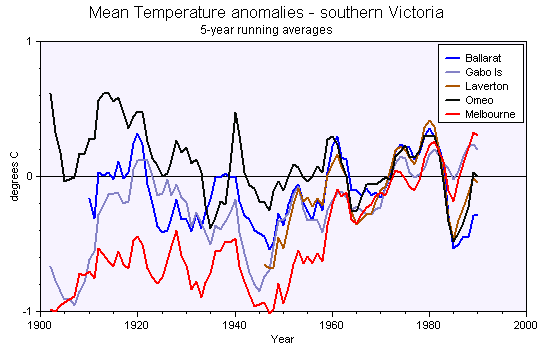
We showed previously how much Melbourne temperatures have been increasing. But how much of this is due to global warming and how much is due to the fact that it is situated near a 6 lane road, high skyscrapers and street lights lighting it up at night?
Well we can actually compare Melbourne to Laverton, which is just a good 15 minute drive from the Melbourne site. Whilst we don't expect the two to follow suit exactly, with only a small driving distance between them we should expect only small white noise errors if there was no problem with urban warming.
Unfortunately this is not what we get. Starting from 1955, shown below is the difference between Melbourne and Laverton temperature anomalies for average temperature (average of max and min).

The rate of increase is obvious. IN fact it is increasing at more than 2 degrees every 100 years. The minimum temperature increase was even greater at 3 degrees per 100 years or at 3 times the supposed global mean increase due to global warming. The Urban Heat Island effect obviously has a major influence in the temperature data, so much so that at some stations it can increase it by up to 3 times he normal amount.
Whilst there is debate over to its use in global warming analysis. (this website say that it is not used, this article suggests that it is used in much research, and this Australian Bureau of Meteorology website suggests that it is used in temperature maps, as well as a personal email from the BOM that says that it does, and it is also included in the Australian temperature extreme analysis), there are some big applications in these findings.
Firstly, is suggests that the Urban Heat Island effect is real. This goes against research by Peterson (2003) who indicated that "Contrary to generally accepted wisdom, no statistically significant impact of urbanization could be found in annual temperatures.
Parker (2004) suggested that the Urban heat island effect didn't exist because calm nights were as warm and windy nights (huh???).
Even the IPCC (2007) concluded that
"the global land warming trend discussed is very unlikely to be influenced significantly by increasing urbanisation"
If this is the case, can you explain the above graph? And this one as well as shown on this website?
Granted of course, that this is an extreme case. The weather station might well have been plotted on a few squared of grass, but amongst cars, trams, concrete, street lights etc. Not all stations are like this. However whatts up with that suggests that this is far from a one off occurrence.
So if Melbourne's Urban Heat Island Effect makes a 2 degree increase in temperature per 100 years, and a 3 degree increase in minimum temperatures, then how much will a small urban effect make? Half a degree? One degree?
Either way, the IPCC is clearly only kidding themselves that the Urban Heat Island effect is insignificant. The graph above is significant at less than the 0.001 level of significance.
Well we can actually compare Melbourne to Laverton, which is just a good 15 minute drive from the Melbourne site. Whilst we don't expect the two to follow suit exactly, with only a small driving distance between them we should expect only small white noise errors if there was no problem with urban warming.
Unfortunately this is not what we get. Starting from 1955, shown below is the difference between Melbourne and Laverton temperature anomalies for average temperature (average of max and min).
The rate of increase is obvious. IN fact it is increasing at more than 2 degrees every 100 years. The minimum temperature increase was even greater at 3 degrees per 100 years or at 3 times the supposed global mean increase due to global warming. The Urban Heat Island effect obviously has a major influence in the temperature data, so much so that at some stations it can increase it by up to 3 times he normal amount.
Whilst there is debate over to its use in global warming analysis. (this website say that it is not used, this article suggests that it is used in much research, and this Australian Bureau of Meteorology website suggests that it is used in temperature maps, as well as a personal email from the BOM that says that it does, and it is also included in the Australian temperature extreme analysis), there are some big applications in these findings.
Firstly, is suggests that the Urban Heat Island effect is real. This goes against research by Peterson (2003) who indicated that "Contrary to generally accepted wisdom, no statistically significant impact of urbanization could be found in annual temperatures.
Parker (2004) suggested that the Urban heat island effect didn't exist because calm nights were as warm and windy nights (huh???).
Even the IPCC (2007) concluded that
"the global land warming trend discussed is very unlikely to be influenced significantly by increasing urbanisation"
If this is the case, can you explain the above graph? And this one as well as shown on this website?
Granted of course, that this is an extreme case. The weather station might well have been plotted on a few squared of grass, but amongst cars, trams, concrete, street lights etc. Not all stations are like this. However whatts up with that suggests that this is far from a one off occurrence.
So if Melbourne's Urban Heat Island Effect makes a 2 degree increase in temperature per 100 years, and a 3 degree increase in minimum temperatures, then how much will a small urban effect make? Half a degree? One degree?
Either way, the IPCC is clearly only kidding themselves that the Urban Heat Island effect is insignificant. The graph above is significant at less than the 0.001 level of significance.
Windy claims for wind farms exposed
The latest VENCorp annual planning report has yet more bad news for wind farms.
To the usual problems - that when the wind don’t blow, the power don’t flow - add the fact that the ones already installed at great expense aren’t producing as much power as promised.
From pages 30 and 33 we read that VENCorp has had to revise future summer wind generation from 24 per cent to 23 per cent of installed capacity, and winter wind generation even further down - from 27 per cent to just 19 per cent of capacity.
This is “based on the analysis of actual half-hourly wind generation during peak times”. Ugly, expensive and next to useless.
Thanks Andrew

To the usual problems - that when the wind don’t blow, the power don’t flow - add the fact that the ones already installed at great expense aren’t producing as much power as promised.
From pages 30 and 33 we read that VENCorp has had to revise future summer wind generation from 24 per cent to 23 per cent of installed capacity, and winter wind generation even further down - from 27 per cent to just 19 per cent of capacity.
This is “based on the analysis of actual half-hourly wind generation during peak times”. Ugly, expensive and next to useless.
Thanks Andrew
Friday, October 26, 2007
Wrong predictions on active 2007 hurricane season
2007 saw predictions of a very active hurricane season. The predictions even got upgraded to be even worse. NOAA predicted a 85% chance of having a season above normal, and only a 5% chance of having a season below normal. And didn't the newspaper love it. Plenty of reports here and here.
But the result? well with hurricane season ending Nov 30th, is looking well below normal. According to COAPS: “Unless a dramatic and perhaps historical flurry of activity occurs in the next 11 weeks (ACE is based on calendar year, not traditional June-November hurricane season) , 2007 will rank as a historically inactive Tropical Cyclone year for the entire Northern Hemisphere.

But the result? well with hurricane season ending Nov 30th, is looking well below normal. According to COAPS: “Unless a dramatic and perhaps historical flurry of activity occurs in the next 11 weeks (ACE is based on calendar year, not traditional June-November hurricane season) , 2007 will rank as a historically inactive Tropical Cyclone year for the entire Northern Hemisphere.
Wednesday, October 24, 2007
Melbourne, beautiful city - terrible data
As shown on Whatts Up With That? they have taken a good look at the primary Melbourne based weather station. Being a Melbourne person myself, I have passed this weather station many times. It's basically in the middle of Melbourne, whilst the Carlton gardens are on the opposite side of the very wide Victoria Street, this intersection comes to an almost standstill in peak our and it is a major access to the central hub of the city from the north.

But it wont stop there, at night, Victoria street and La Trobe street is lit up by street lights. Not country style street lights, but city street lights, so there is not a single section of the area under shade.
View the map here.
So how have the records gone for this station? You guessed it, increases in maximum temperature and minimum temperature, even increases before bitumen was invented. So surprises really, in fact temperatures at Midnight, 3am, 6am, 9a, Noon, 3pm, 6pm and 9pm have all seen increases.


No surprises really. With cars and concrete buzzing past during the night, and under constant heat lights at night, well, the conclusion answers itself.
And as for rainfall? well there's a reasonable chance that the surrounding sky scrapers eliminate some of this, and the last 10 years has seen decreases despite no significant difference. Ohh,and don't even bother getting meaningful readings about Sunshine duration or wind.
But it wont stop there, at night, Victoria street and La Trobe street is lit up by street lights. Not country style street lights, but city street lights, so there is not a single section of the area under shade.
View the map here.
So how have the records gone for this station? You guessed it, increases in maximum temperature and minimum temperature, even increases before bitumen was invented. So surprises really, in fact temperatures at Midnight, 3am, 6am, 9a, Noon, 3pm, 6pm and 9pm have all seen increases.
No surprises really. With cars and concrete buzzing past during the night, and under constant heat lights at night, well, the conclusion answers itself.
And as for rainfall? well there's a reasonable chance that the surrounding sky scrapers eliminate some of this, and the last 10 years has seen decreases despite no significant difference. Ohh,and don't even bother getting meaningful readings about Sunshine duration or wind.
Variations in max temp suggest Sun Caused Global Warming
We showed before about the variations between minimum temperature and that at 3am and 6am. But what about the differences between maximum temperature anomalies and temperatures at say, Noon, 3pm and 6pm? What would we expect?
Well if the CO2 blanket was the major cause of global warming then we would see increased temperature, relatively constant throughout the day. Unfortunately this, as we have shown doesn't occur in Australia at night. However we have shown that maximum temperatures, just like temperatures at 9am, Noonand 3pm all have shown a significant increase in temperature. 6pm and 9pm failed to record a significant increase.
Has the maximum temperature increased at the same rate as temperatures at these times? Well if the sun was the major source of global warming, then unless the maximum occurred all the time at say, 3pm, then maximum temperatures should have increased at a greater rate than those at recorded specific times.
Shown below is the difference in monthly temperature anomalies of maximum temperature and 9am. As one can see, there doesn't seem to be much of a linear trend. A possible cyclic trend might exist, but there is not enough data t prove either way.

However as shown below the difference in monthly temperature anomalies of maximum temperature and Noon is starting to shape form. Whilst in more recent years (since around 1992) there has been no major difference, beforehand there was a significant increasing trend indicating that temperature anomalies at he maximum were increasing at a greater rate than temperatures at Noon.

Shown below are the differences in monthly temperature anomalies of maximum temperature and 3pm and 6pm.


The pattern is obvious. In fact maximum temperatures anomalies have been increasing with respect to 3pm temperatures at a rate of 0.0054 degrees per year or 0.34 degrees since 1943. And the increase compared to 6pm is at a rate of 0.0131 degrees per year or 0.83 degrees since 1943.
The graph of the different between maximum temperature and 9pm is shown below which shows a gradual but not not as significant trend.

So this tells us a few things. Firstly, the maximum temperature anomalies are increasing at a greater rate than temperatures at strict consistent times. Hence we are of more recent times getting more "spikes" around the maximum temperature during the day.
The Australian Bureau of Statistics would no doubt agree with this conclusion as they show that their amount of Warm Days has remained relatively steady bar an increase in the last 5 years.
It also means that using the variable maximum temperature over exaggerates the amount of warming that Australia has actually seen. A more accurate measure would be an average of all increases at each of the 8 constant times of the day/night.
But it also means something else, that temperatures are not increasing constantly throughout the day and night. We have shown earlier that temperatures at night are not increasing and have also suggested here that maximums are increasing at a greater rate over the years that constant times at Noon, 3pm and 6pm. Hence it seems that either the sun is a larger contributer to global warming, or that the CO2 greenhouse blanket is ineffective at night, and is only effective as the sun has a greater influence during the day.
Hence still, the reliance on the sun. But is there more evidence of sun caused global warming in the time based temperature anomalies? You bet. Next we will prove to you about the rate of change of temperature anomalies as we approach the heat of the day and move from it, and it is devastating evidence indeed.
Well if the CO2 blanket was the major cause of global warming then we would see increased temperature, relatively constant throughout the day. Unfortunately this, as we have shown doesn't occur in Australia at night. However we have shown that maximum temperatures, just like temperatures at 9am, Noonand 3pm all have shown a significant increase in temperature. 6pm and 9pm failed to record a significant increase.


Has the maximum temperature increased at the same rate as temperatures at these times? Well if the sun was the major source of global warming, then unless the maximum occurred all the time at say, 3pm, then maximum temperatures should have increased at a greater rate than those at recorded specific times.
Shown below is the difference in monthly temperature anomalies of maximum temperature and 9am. As one can see, there doesn't seem to be much of a linear trend. A possible cyclic trend might exist, but there is not enough data t prove either way.
However as shown below the difference in monthly temperature anomalies of maximum temperature and Noon is starting to shape form. Whilst in more recent years (since around 1992) there has been no major difference, beforehand there was a significant increasing trend indicating that temperature anomalies at he maximum were increasing at a greater rate than temperatures at Noon.
Shown below are the differences in monthly temperature anomalies of maximum temperature and 3pm and 6pm.
The pattern is obvious. In fact maximum temperatures anomalies have been increasing with respect to 3pm temperatures at a rate of 0.0054 degrees per year or 0.34 degrees since 1943. And the increase compared to 6pm is at a rate of 0.0131 degrees per year or 0.83 degrees since 1943.
The graph of the different between maximum temperature and 9pm is shown below which shows a gradual but not not as significant trend.
So this tells us a few things. Firstly, the maximum temperature anomalies are increasing at a greater rate than temperatures at strict consistent times. Hence we are of more recent times getting more "spikes" around the maximum temperature during the day.
The Australian Bureau of Statistics would no doubt agree with this conclusion as they show that their amount of Warm Days has remained relatively steady bar an increase in the last 5 years.
It also means that using the variable maximum temperature over exaggerates the amount of warming that Australia has actually seen. A more accurate measure would be an average of all increases at each of the 8 constant times of the day/night.
But it also means something else, that temperatures are not increasing constantly throughout the day and night. We have shown earlier that temperatures at night are not increasing and have also suggested here that maximums are increasing at a greater rate over the years that constant times at Noon, 3pm and 6pm. Hence it seems that either the sun is a larger contributer to global warming, or that the CO2 greenhouse blanket is ineffective at night, and is only effective as the sun has a greater influence during the day.
Hence still, the reliance on the sun. But is there more evidence of sun caused global warming in the time based temperature anomalies? You bet. Next we will prove to you about the rate of change of temperature anomalies as we approach the heat of the day and move from it, and it is devastating evidence indeed.
Tuesday, October 23, 2007
Rewording ClimateChangeinAustralia Part 1
Original:
"About half of all tornadoes in Australia occur during May to October." (page 23)
My recommended rewording:
"About half of all tornadoes in Australia occur during May to October, as do almost half the months of the year"
"About half of all tornadoes in Australia occur during May to October." (page 23)
My recommended rewording:
"About half of all tornadoes in Australia occur during May to October, as do almost half the months of the year"
Monday, October 22, 2007
McIntyre v Peterson on Urban Heat Islands
Canadian mathematician and climate scientist Steve McIntyre has found another striking error in the academic work supporting the case for climate alarmism.
Recall, in August McIntyre found an error in the way NASA was collating the temperature records from 1200 North American monitoring stations operating since the 1870s. NASA admitted the error, acknowledging they had been overstating the warming in North America since 1930 by a factor of 1.75x. (We wrote about the incident here, here, here, and here.)
This week McIntyre got his hands on the source data cited in an influential 2003 paper claiming the Urban Heat Island effect not having an important impact on historical temperature measurements. The article suggestively titled, Assessment of Urban Versus Rural In Situ Surface Temperatures in the Contiguous United States: No Difference Found, claimed:
Contrary to generally accepted wisdom, no statistically significant impact of urbanization could be found in annual temperatures.
Using the same data (sent to him by the author Thomas Peterson) McIntyre this claim to be completely unsupported. Here’s McIntyre’s plot of data, separating urban and rural monitoring stations based on Peterson’s own definition (click to enlarge):

Its painfully obvious to the most casual observer that there’s a strong warming trend among urban stations, and none for the rural ones.
McIntyre cuts the data another way. Rather than using Peterson’s definition of what constitutes an urban station, he looks at stations in cities with NFL teams (he calls them ‘major cities’) versus everything else. Here’s the graph (click to enlarge):

Three Questions to the CSIRO
1. The CSIRO claim that we have seen an increased frequency in hot nights and a decreased frequency in cold nights. This is based on the statistic minimum temperature. Considering that the minimum temperature will generally occur after sunrise, can you explain why you choose to use the statistic minimum temperature to talk about temperatures at night, when in the minimum generally doesn't even occur at night?
2. Can you please explain the predictions of increased drought and flooding, coupled with a decrease in rainfall when you consider that the second half of the 20th century had a 9.5% increase in rainfall compared to the first half of the 20th century (an increase in every state), and that the number of very wet days and not significantly increased or decreased, neither has the number of days of no rainfall?
3. As Kerplunk puts it "If 'the science is settled' then why does the United Nations' IPCC need 17 climate models when just one should do?"
2. Can you please explain the predictions of increased drought and flooding, coupled with a decrease in rainfall when you consider that the second half of the 20th century had a 9.5% increase in rainfall compared to the first half of the 20th century (an increase in every state), and that the number of very wet days and not significantly increased or decreased, neither has the number of days of no rainfall?
3. As Kerplunk puts it "If 'the science is settled' then why does the United Nations' IPCC need 17 climate models when just one should do?"
Subscribe to:
Posts (Atom)