Opps,
Rajendra Pachauri, head of the IPCC seems to have spilled the beans here:
There is no clear evidence that global warming is an imminent danger to the world, says Rajendra Pachauri, chairman of the United Nations' Intergovernmental Panel on Climate Change.
But even so why not continue to cut emmissions even though thre is no clear evidence of danger to the world:
Even so, it would be good for governments to go further with proposed cuts in greenhouse-gas emissions to deal with dire predictions made in a 2007 panel report, he told the Associated Press in an interview on Tuesday.
It would be good? so what, it doesn't really matter, but it'd be good if it happened?
Tuesday, December 16, 2008


Rudd to decrease emissions by how much?
Almost exactly a year ago, Kevin Rudd supported cutting greenhouse emissions by 25 to 40%:
THE Prime Minister, Kevin Rudd, signalled his support for developed countries, including Australia, agreeing to making deep cuts in their greenhouse gas emissions in the next 12 years.
In a significant move last night the Australian delegation to the UN climate talks stated it "fully supports" the proposal that developed countries need to cut their greenhouse gas emission by 25 to 40 per cent by 2020.
But just yesterday, the Prime Minister announced a 5% reduction is his plan on cutting the deadly gas by 2020. So what does 5% actually mean? Bob Brown and the Greens for example, want a 100% reduction.
Well Australa's CO2 emmisions are currently at 326,000 thousand metric tonnes. Which is about 1.2% of the worlds.
If we assume that CO2 has caused 100% of the 0.7 degre increase that we have seen over the past 100 years (extremly unlikely - even the IPCC don't perscribe to this, but still - for interests sake), then australia cutting greenshouse gasses by 5% will result in a decrease of
0.00042 degrees per 100 years, or
0.0000042 degree decrease per year.
Well done Kevid Rudd!!
THE Prime Minister, Kevin Rudd, signalled his support for developed countries, including Australia, agreeing to making deep cuts in their greenhouse gas emissions in the next 12 years.
In a significant move last night the Australian delegation to the UN climate talks stated it "fully supports" the proposal that developed countries need to cut their greenhouse gas emission by 25 to 40 per cent by 2020.
But just yesterday, the Prime Minister announced a 5% reduction is his plan on cutting the deadly gas by 2020. So what does 5% actually mean? Bob Brown and the Greens for example, want a 100% reduction.
Well Australa's CO2 emmisions are currently at 326,000 thousand metric tonnes. Which is about 1.2% of the worlds.
If we assume that CO2 has caused 100% of the 0.7 degre increase that we have seen over the past 100 years (extremly unlikely - even the IPCC don't perscribe to this, but still - for interests sake), then australia cutting greenshouse gasses by 5% will result in a decrease of
0.00042 degrees per 100 years, or
0.0000042 degree decrease per year.
Well done Kevid Rudd!!
Monday, November 10, 2008
Global Warming to increase crime levels
Yep, apparently according to the ABC:
A new report from the Strategic Policy Institute says climate change could lead to an increase in crime.
...the report's author, Anthony Bergin, is predicting global warming will lead to an increase in violent crime and so called 'climate crime'.
More police resources may be needed to cope with an influx of migrants from low lying areas as the sea level rises.
Please
A new report from the Strategic Policy Institute says climate change could lead to an increase in crime.
...the report's author, Anthony Bergin, is predicting global warming will lead to an increase in violent crime and so called 'climate crime'.
More police resources may be needed to cope with an influx of migrants from low lying areas as the sea level rises.
Please
Friday, November 07, 2008
Everything back to normal! Phew!
Accoring to Geliogenic Climate Change, tropical cyclones are back to normal:
Link here:
And after one of the most quickest and amazing turns of ice coverage on record, Global ice records are currently at the same level as 1979:
Graph here:
Thank goodness for that, for a while I was getting scared, very very scared.
Link here:

And after one of the most quickest and amazing turns of ice coverage on record, Global ice records are currently at the same level as 1979:
Graph here:

Thank goodness for that, for a while I was getting scared, very very scared.
Tuesday, November 04, 2008
The pointlessness of a Prius
Australian Climate Madness explains the pointlessness of hybrid cars:
The latest advert for the Toyota Prius claims that by driving one for 10 years or 100,000km, you can save 7.5 tonnes of CO2 as compared to a regular petrol-engined car.
Let's put that into perspective. If you drove a Prius for, say, 70,000 years, you would save the same amount of CO2 that a large coal-fired power station generates in a day.
Moral of the story: don't fool yourself into thinking that driving a butt-ugly hybrid car is anything but a feel-good gesture.
The latest advert for the Toyota Prius claims that by driving one for 10 years or 100,000km, you can save 7.5 tonnes of CO2 as compared to a regular petrol-engined car.
Let's put that into perspective. If you drove a Prius for, say, 70,000 years, you would save the same amount of CO2 that a large coal-fired power station generates in a day.
Moral of the story: don't fool yourself into thinking that driving a butt-ugly hybrid car is anything but a feel-good gesture.
Friday, October 31, 2008
Fly everywhere to see everything before it disappears
Frommers has released its latest book:
500 Places to see before they disappear.
A lot of the places are, according to the book, going to disappear due to global warming. The whole of Tasmania is on the endagered list apparently. And there are several places on the list that you must je set across the universe to see because they will shortly (maybe in several thousand years) fall below sea level due to rising sea levels.
Fommers have done their part and sent copies of the book all around the world by plane for you to buy, so its up to you to jet set around the world vising everywhere before the CO2 levels that you guzzle out destroy the actal things that you want to see.
Hmmm....
500 Places to see before they disappear.
A lot of the places are, according to the book, going to disappear due to global warming. The whole of Tasmania is on the endagered list apparently. And there are several places on the list that you must je set across the universe to see because they will shortly (maybe in several thousand years) fall below sea level due to rising sea levels.
Fommers have done their part and sent copies of the book all around the world by plane for you to buy, so its up to you to jet set around the world vising everywhere before the CO2 levels that you guzzle out destroy the actal things that you want to see.
Hmmm....
Monday, October 20, 2008
Natural History? What History?
New Yorks Natural History Museum decides to open the floodgates into non lived "history". Somehow through propaganda:
Water, 16 feet of it, smothers the southern tip of Manhattan, covering the landfill of Battery Park City. Tropic coral reefs are stripped of life, their rocks pocked with contusions. Polar bears rummage in junk heaps seeking food amid construction debris. Glaciers split into ice chips, floods ravage coastlines, droughts parch the Earth and forest fires rage untamable.
If the End of Days were going to be portrayed in a museum exhibition, it might look like the array of natural disasters, both real and imagined, that can be found at “Climate Change,” which opens Saturday at the American Museum of Natural History.
There is something almost biblical about these worst-case scenarios, apocalyptically suggested even in the subtitle: “The Threat to Life and a New Energy Future.” And if the plagues promised with global warming don’t include an onslaught of frogs, there is more than enough to worry about: the exhibition predicts proliferation of malaria and desperate foraging of wildlife.

Water, 16 feet of it, smothers the southern tip of Manhattan, covering the landfill of Battery Park City. Tropic coral reefs are stripped of life, their rocks pocked with contusions. Polar bears rummage in junk heaps seeking food amid construction debris. Glaciers split into ice chips, floods ravage coastlines, droughts parch the Earth and forest fires rage untamable.
If the End of Days were going to be portrayed in a museum exhibition, it might look like the array of natural disasters, both real and imagined, that can be found at “Climate Change,” which opens Saturday at the American Museum of Natural History.
There is something almost biblical about these worst-case scenarios, apocalyptically suggested even in the subtitle: “The Threat to Life and a New Energy Future.” And if the plagues promised with global warming don’t include an onslaught of frogs, there is more than enough to worry about: the exhibition predicts proliferation of malaria and desperate foraging of wildlife.

PDO and temperature trends
The Pacific Decadal Oscillation (PDO) was switching into cool and/or warm modes almost exactly when cooling/warming trends began in the 20th century.
This observation has been known to Joe D'Aleo and others for years. Roy Spencer is now completing a paper for Geophysical Research Letters in which he quantifies these relationships:
Weather Questions, Anthony Watts's blogSpencer assumes that the cloud cover is affected by the PDO index - which is almost certainly the case, the only question is "how much". These variations influence the deeper ocean where the heat may be stored and mixed for many decades or a century. Finally, he puts these things together to optimally match the thermometer data.
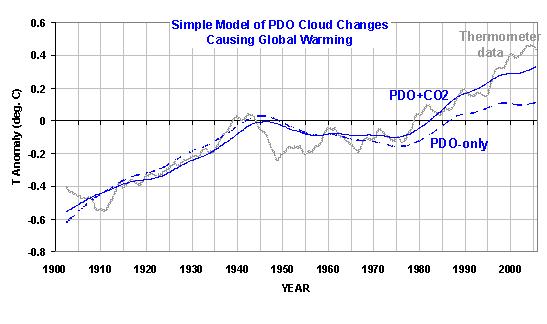
You can see that the PDO-only model describes the temperature pretty well at the qualitative level, including the slight cooling between the 1940s and late 1970s. However, the fit gets improved if you add a term proportional to the CO2 concentration. However, such an addition only adds 0.2 °C to the temperature or so - close to the expected effect of CO2 throughout the 20th century. It shouldn't be shocking that the resulting CO2-induced warming for the 21st century is well below 1 °C, too.

Incidentally, the highly asymmetric (red) IPCC range indicates that what dominates their calculations of the sensitivity is not a full-fledged model of reality but a set of priors. If they had a full model, the 90% confidence level range would be pretty much symmetrically distributed around the most likely central value.
In fact, it's known that the upper bound of the confidence interval depends almost exclusively on priors - how much you are willing to admit a crazily high sensitivity in the first place. Because the amount of non-trivial data (inferences) they apply to refine the estimate is low, the prior prejudices are not affected too much. A typical example of a prejudice-dominated science.
Spencer and Braswell ended up with a 0.6 °C warming for the 21st century only but I guess that Lindzen would still beat them by a little bit.
Thanks lubos
Friday, October 17, 2008
Alaska saved
Sunday, October 12, 2008
Subscribe to:
Posts (Atom)